Last update: September 23, 2026
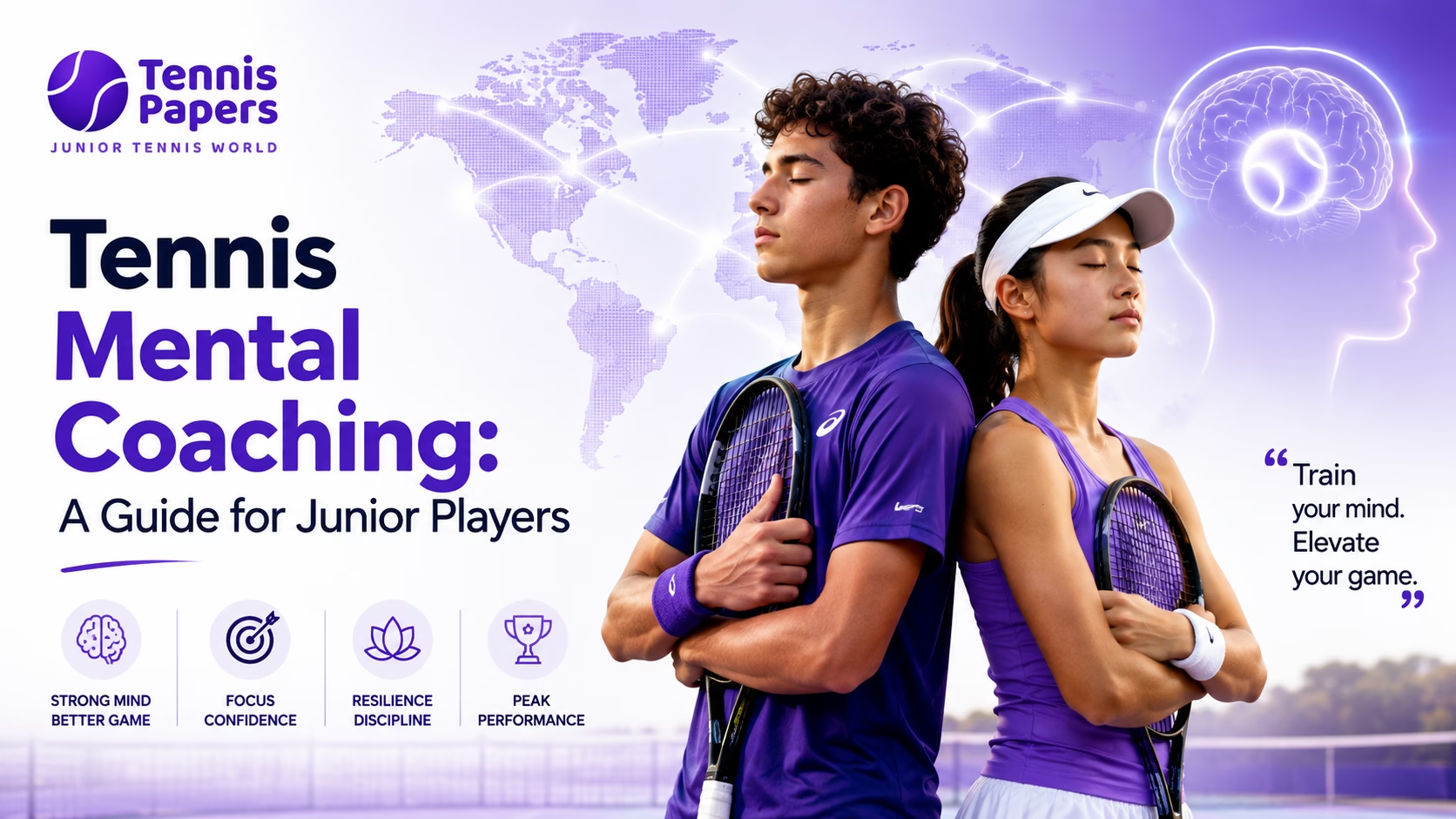
Mental strength plays a major role in junior tennis. Young players must learn to manage pressure, maintain confidence, recover from difficult defeats and stay focused through the ups and downs of competition.
Tennis mental coaching can help junior players develop these skills alongside their technical, tactical and physical training.
This guide explains how mental coaching works, when young tennis players can start working on their mental game, the areas a mental coach can help with and how parents can support the process.
Quick Navigation
What Is Tennis Mental Coaching?
Tennis mental coaching focuses on the psychological skills that can help players perform more effectively in training and competition.
Unlike technical coaching, which focuses primarily on strokes, movement and tactics, mental coaching works on areas such as confidence, concentration, emotional control, motivation and the ability to respond positively to pressure and setbacks.
For junior players, these skills can become increasingly important as competition becomes more demanding.
Why Is the Mental Game So Important in Junior Tennis?
Tennis presents particular mental challenges because players compete individually and must make decisions continuously throughout a match.
There is no teammate to take over after a mistake and, in most junior competitions, players must learn to solve problems independently on court.
Young players may have to deal with:
- pressure before and during matches;
- fear of losing;
- frustration after mistakes;
- changes in confidence;
- difficult defeats;
- expectations from themselves or others;
- comparison with other players;
- ranking pressure;
- maintaining motivation over a long season.
Developing the mental side of the game can help players respond to these situations more constructively.
What Does a Tennis Mental Coach Work On?
The exact approach depends on the player, but mental coaching may address several areas.
Confidence
Players can learn to understand where their confidence comes from and how to prevent individual mistakes or defeats from defining their perception of their ability.
Managing Pressure
Competitive tennis regularly creates stressful situations: serving for a match, playing a tiebreak, facing a higher-ranked opponent or competing in an important tournament.
Mental coaching can provide strategies for approaching these situations more effectively.
Focus and Concentration
Players need to remain focused while constantly moving between points, games and sets.
Mental work can help them concentrate on what they can control rather than becoming distracted by the score, opponent, crowd or previous mistakes.
Dealing With Defeat
Losing is an unavoidable part of competitive tennis.
Learning to analyse a defeat, identify useful lessons and move forward can help young players turn difficult experiences into part of their development.
Goal Setting
Long-term ambitions can be motivating, but players also need realistic and measurable short-term objectives.
A mental coach can help structure goals around development rather than focusing exclusively on rankings and results.
Emotional Control
Frustration, anger, nervousness and disappointment can all influence decision-making on court.
Mental coaching does not aim to eliminate emotions, but can help players recognise and manage them more effectively.
At What Age Should Junior Tennis Players Start Mental Coaching?
There is no universal age at which every player should begin mental coaching.
The appropriate moment depends on factors such as maturity, competitive experience and the player’s ability to understand and apply the concepts being discussed.
Mental skills can nevertheless be introduced progressively from a young age through simple concepts such as routines, concentration, emotional awareness and constructive responses to mistakes.
More structured individual mental coaching may become appropriate as players mature and competition becomes more demanding.
Mental Coach vs Tennis Coach: What Is the Difference?
A tennis coach and a mental coach have different but potentially complementary roles.
The tennis coach primarily develops the player’s technical, tactical and physical performance on court.
A mental coach focuses specifically on psychological and behavioural aspects of performance.
Ideally, the different members of a player’s team communicate so that technical, physical and mental development support the same overall objectives.
What Role Should Parents Play?
Parents can have a significant influence on a young player’s relationship with competition.
Support does not necessarily mean analysing every match or focusing on results.
Parents can help by creating an environment in which effort, learning, discipline and long-term development remain important regardless of individual wins and losses.
When a player works with a mental coach, communication between the player, parents and coaching team can also help maintain consistent objectives.
How to Choose a Mental Coach for a Junior Tennis Player
Families considering mental coaching should look beyond social media visibility or motivational language.
Useful questions include:
- What qualifications and coaching experience does the person have?
- Have they worked with junior athletes?
- Do they understand competitive tennis?
- How do they adapt their approach to the player’s age?
- How do they communicate with parents and the tennis coach?
- What objectives will be established?
- How will progress be evaluated?
- How frequently will sessions take place?
The relationship between the player and mental coach is also important. A young athlete needs to feel comfortable communicating openly and engaging with the process.
Dr. Jim Loehr — A Pioneer of Mental Toughness in Tennis
Dr. Jim Loehr was one of the pioneers of performance psychology and mental toughness training in tennis. His work focused on a simple but powerful idea: mental toughness is not just something a player either has or does not have — it can be developed through deliberate habits, routines, and emotional control.
One of Loehr’s best-known contributions to tennis is the “16-Second Cure”, a structured routine designed to help players use the time between points to recover mentally and physically. Instead of dwelling on the previous point, players learn to reset through positive body language, relaxation and breathing, preparation for the next point, and a consistent pre-point ritual.
For junior players, Loehr’s principles can be translated into practical habits: control your eyes, breathe deeply, maintain positive body language, manage mistakes quickly, avoid destructive self-talk, use consistent routines, regulate your intensity, and focus on the point you are playing rather than the previous point or the final result.
Practical Mental Toughness Principles Inspired by Jim Loehr’s Work
Eye Control
Control where you look. A steady visual focus helps reduce distractions and brings your attention back to the present.
Rituals
Develop consistent routines between points and before serving or returning. Familiar rituals create stability under pressure.
Breathing
Use controlled breathing to release tension, regulate emotions, and recover between points.
Positive Intensity
Bring energy to the court without losing emotional control. Aim for purposeful intensity rather than uncontrolled emotion.
Constructive Self-Talk
Replace destructive self-criticism with short, useful cues that help you prepare for the next point.
Relaxation
Release unnecessary tension between points. Relax the shoulders, loosen the grip, and breathe out.
Mistake Management
Accept what happened, learn what is useful, and move on. Never allow one mistake to affect the next point.
Positive Attitude
Respond to difficult moments with solutions rather than frustration, especially when things are not going well.
Enjoy the Challenge
Embrace competition and pressure. Difficult moments are part of the challenge rather than something to fear.
Racquet Head Up
Use your racquet and posture as part of positive body language, particularly after difficult points.
Strong Body Language
Walk with purpose and maintain confident posture. Your physical response can influence your emotional state.
Present-Point Focus
Stay with the point in front of you. The previous point is finished and the final result is still in the future.
Expert Insights: Omar Fayez
Egyptian Sports Mental Coach Omar Fayez works with athletes on the psychological aspects of performance and has experience with junior tennis players competing on the ITF circuit.
His own interest in the mental game developed through his experience as a tennis player.
In his exclusive Inside Tennis interview with Tennis Papers, Fayez discusses confidence, pressure, defeats, goal setting, parents’ involvement and some of the most common mental challenges he observes among junior players.
The best advice I can give them is to treat loss as feedback, not criticism.
Read the full interview: Inside Tennis: Mental Coaching with Omar Fayez
Mental Coaching Is One Part of Player Development
Mental coaching should not be viewed as a replacement for technical training, physical preparation or competition experience.
Instead, it can become another component of a player’s overall development.
Technical ability helps a player produce the shots. Physical preparation helps the player execute them repeatedly. Tactical understanding helps determine which shot to play.
Mental skills can help the player access those abilities when competition becomes difficult.
For junior players with long-term ambitions, learning how to manage confidence, pressure, mistakes and setbacks can therefore be an important part of becoming a more complete competitor.
Continue Exploring Tennis Papers
Discover more junior tennis resources, including player interviews, rankings, tournaments, academies, sponsorship and career development.