
Last update: November 29, 2026
Junior Tennis Equipment & Technology
Choosing the right junior tennis equipment is an important part of player development. From racquets and strings to footwear, training machines and digital performance tools, equipment can influence comfort, preparation and the overall training experience.
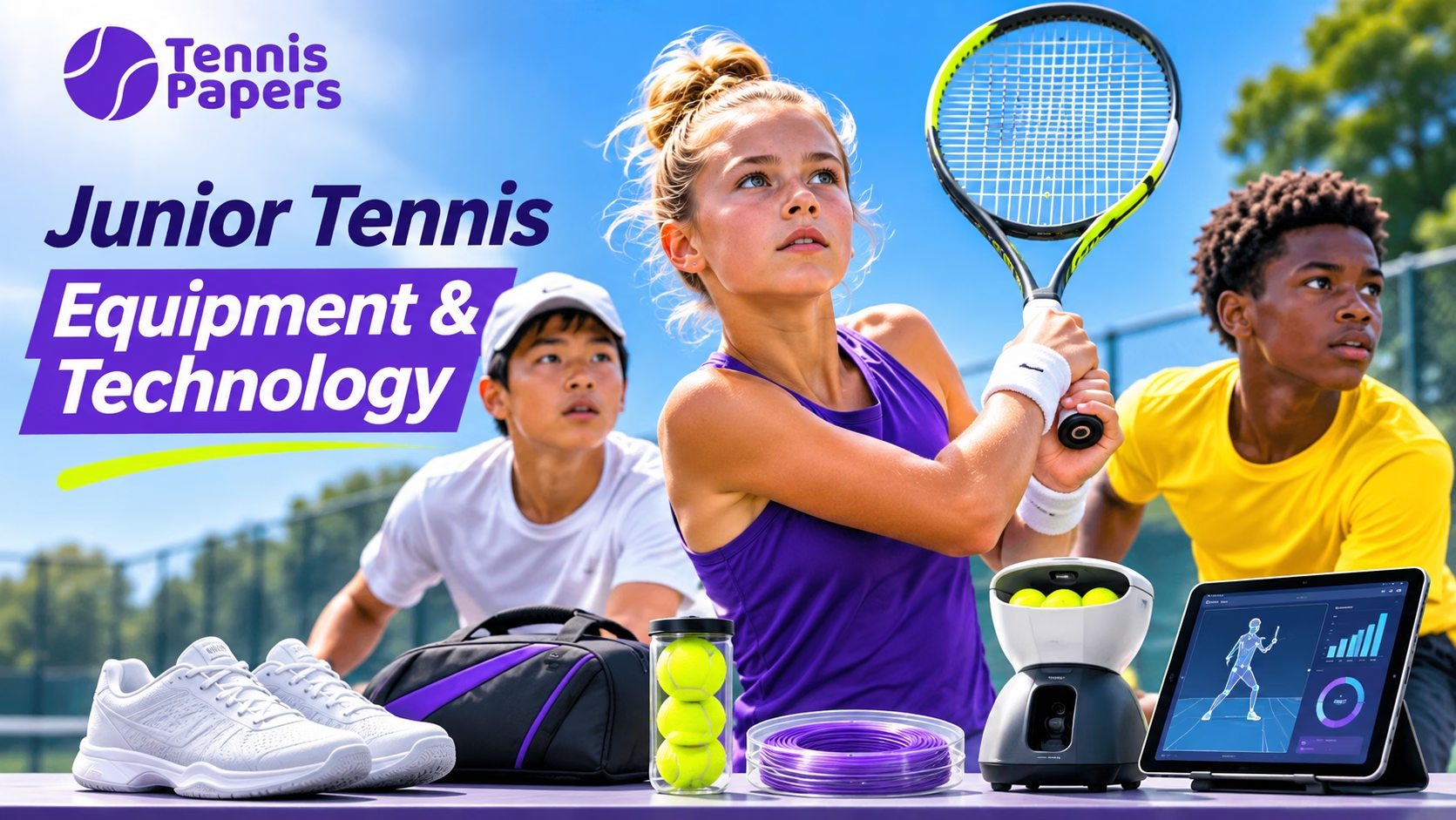
Tennis Papers explores the equipment, brands and technologies used across the junior tennis world. Discover practical guides, product categories, training innovations and digital applications designed for players, parents, coaches and academies.
Our goal is to help the junior tennis community better understand the available options and make informed decisions based on individual needs, playing levels and development goals.
Quick Navigation
Junior Tennis Racquets: Size, Weight & Performance
Choosing the right junior tennis racquet is an important part of a young player’s development. Racquet length, weight, balance and grip size can influence comfort, manoeuvrability and the ability to develop effective technique.
From smaller racquets designed for beginners to full-size performance frames used by advanced juniors, the ideal choice should reflect the player’s height, physical development, playing level and individual needs — not simply their age or favourite professional player’s equipment.
Junior Racquet Size Guide
Racquet Length & Size
Junior racquets typically measure between 17 and 26 inches, compared with the standard 27-inch adult racquet.
The correct length depends primarily on the player’s height, coordination and ability to swing comfortably.
Weight & Balance
Racquet weight influences manoeuvrability, stability and the physical effort required during strokes.
A junior player should be able to accelerate and control the racquet comfortably without excessive strain or fatigue.
Grip Size & Comfort
Grip size should allow a secure, comfortable hold without unnecessary tension in the hand or forearm.
Frame construction, head size and string setup should also be considered when evaluating comfort and control.
Tennis Papers Insight: Choose Fit Before Brand
A racquet used by an ATP or WTA professional is not automatically suitable for a junior player. The right frame should support comfortable movement, sound technique and progressive development.
Whenever possible, players should test different racquet sizes and weights with their coach before making a decision.
Key principle: Choose a racquet that suits the player today, rather than a heavier or longer model they may only be ready to use in the future.
Junior Tennis Shoes
Choosing the right junior tennis shoes is essential for comfort, stability and movement on court. Unlike regular running shoes, tennis footwear is designed for lateral movements, quick changes of direction and frequent stops.
The ideal shoes depend on the player’s foot shape, playing surface, training intensity and individual preferences. From durable hard-court models to clay-court shoes designed for controlled sliding, selecting appropriate footwear helps young players move confidently and comfortably.
Tennis Shoes by Court Surface
Hard Court Tennis Shoes
Best suited to: Hard courts and abrasive playing surfaces.
Designed with durable outsoles to withstand repeated movement on hard surfaces, combined with cushioning and lateral support for demanding tennis footwork.
A practical choice for juniors training and competing primarily on hard courts.
Clay Court Tennis Shoes
Best suited to: Clay courts and loose clay surfaces.
Typically feature a herringbone-patterned outsole designed to provide traction, release clay and support controlled sliding movements.
Particularly relevant for junior players competing regularly on European clay courts and other clay-based surfaces.
All-Court Tennis Shoes
Best suited to: Players training on multiple surfaces.
Versatile tennis shoes designed to offer a balance of grip, durability and comfort across different court conditions.
An attractive option for developing juniors who regularly alternate between different training venues and court surfaces.
Fit, Stability & Comfort
Court surface is only one consideration when choosing junior tennis shoes. A comfortable fit, secure heel, sufficient toe room and appropriate lateral support are equally important.
Young players should try shoes with their usual tennis socks and test basic tennis movements before making a decision. Foot size and shoe fit should also be checked regularly as children grow.
Tennis Papers Insight: Fit Before Fashion
Young players should not select tennis shoes solely because they are worn by a favourite ATP or WTA professional.
Fit & Stability: Shoes should hold the foot securely while allowing natural movement and sufficient room around the toes.
Surface Compatibility: Choose an outsole appropriate for the courts used most frequently.
Durability: Check outsole wear, cushioning condition and overall fit regularly, especially during periods of rapid growth.
Key principle: The best junior tennis shoes are those that fit properly and suit the player’s movements, surfaces and training needs.
Junior Tennis Bags
Choosing the right junior tennis bag helps young players organize, protect and transport their equipment comfortably. From compact backpacks for daily practice to larger racquet bags designed for competitive tournaments, different models offer varying levels of storage, protection and convenience.
The ideal tennis bag depends on the player’s age, equipment requirements, training schedule and travel frequency. Practical features such as comfortable straps, dedicated shoe compartments and sufficient racquet storage can make a significant difference in everyday use.
Types of Junior Tennis Bags
Junior Tennis Backpacks
Best suited to: Daily training, local clubs and younger players.
Compact and easy to carry, tennis backpacks generally provide storage for one or two racquets, personal belongings and essential training accessories.
Adjustable shoulder straps and practical compartments make them convenient for regular club sessions and school activities.
Tennis Racquet Bags
Best suited to: Competitive juniors carrying multiple racquets.
Dedicated racquet bags offer larger storage compartments, additional equipment protection and space for clothing, accessories and tournament essentials.
Common capacities include three, six or more racquets, although actual usable storage depends on the bag’s design.
Tournament & Travel Bags
Best suited to: Tournament travel, training camps and extended stays.
Larger sports bags and travel luggage provide additional capacity for clothing, shoes, accessories and personal belongings during multi-day competitions.
Durable materials, organized compartments and practical carrying options are particularly valuable for frequent travellers.
Essential Features of a Junior Tennis Bag
Racquet Protection: Choose a compartment that accommodates the player’s racquets securely. Some larger bags include insulated compartments designed to reduce exposure to temperature changes.
Separate Shoe Storage: A dedicated compartment can help keep dirty shoes away from clothing and other equipment. Ventilation is useful for managing moisture.
Comfortable Carrying System: Adjustable, padded straps can improve comfort, especially for younger players carrying equipment regularly.
Storage Organization: Accessible pockets for water bottles, grips, towels, personal items and other essentials make daily preparation easier.
Durability & Practicality: Strong zippers, resistant fabrics and an appropriate overall size are important for players travelling frequently between clubs and tournaments.
Tennis Papers Insight: Choose Practicality Over Capacity
A large professional racquet bag is not necessarily the best choice for a young player. Excessive capacity can encourage carrying unnecessary equipment and additional weight.
For everyday training: A comfortable tennis backpack may provide all the space a developing junior needs.
For competitive tournaments: A dedicated racquet bag can offer better organization and protection for multiple racquets and additional equipment.
Key principle: Select a bag that matches the player’s actual equipment requirements and can be carried comfortably.
Whether choosing a compact backpack or a larger tournament bag, junior players should prioritize comfort, appropriate storage and equipment protection. The right tennis bag makes preparation easier and supports an organized approach to training and competition.
Junior Tennis Strings
Choosing the right junior tennis strings can influence a player’s comfort, control, power and overall playing experience. String materials, tension and thickness all affect how a racquet responds when striking the ball.
From comfortable synthetic and multifilament strings to firmer polyester options used by advanced competitors, different string types suit different playing styles and physical development stages. For young players, the ideal setup should prioritize comfort, appropriate performance and gradual progression rather than simply copying professional ATP or WTA equipment.
Main Types of Tennis Strings
Synthetic Gut Strings
Best suited to: Beginners and developing junior players.
Usually made from nylon, synthetic gut strings provide a practical balance of comfort, playability and affordability.
They are a popular starting point for juniors who need a versatile string setup without the stiffness often associated with polyester.
Multifilament Strings
Best suited to: Juniors prioritizing comfort, feel and accessible power.
Constructed from numerous fine fibres, multifilament strings generally offer a softer response and greater elasticity than conventional polyester strings.
They can be particularly attractive for young players seeking a comfortable playing experience, although durability varies between models.
Polyester Strings
Best suited to: Physically developed, advanced junior competitors.
Polyester strings are generally firmer and can provide control and spin benefits for players with fast, developed swings.
Their higher stiffness and changing playing characteristics require careful consideration. They are not automatically suitable for young juniors, even when used by professional players.
String Tension, Gauge & Replacement
String Tension: Tension influences the response and feel of the string bed. Lower tensions generally create a more flexible response, while higher tensions can produce a firmer feel. The appropriate tension depends on the racquet, string material and individual player, and should remain within the manufacturer’s recommended range.
String Gauge: String thickness affects durability, feel and playing characteristics. Thinner strings may provide a different response and greater bite on the ball, while thicker strings generally offer improved resistance to breakage. Common string diameters include approximately 1.20 mm, 1.25 mm and 1.30 mm.
String Replacement: Strings lose tension and change their playing characteristics over time, even without breaking. Regular players should monitor string movement, fraying, tension loss and changes in comfort or control. The appropriate restringing frequency depends on the material, playing intensity and individual preferences.
A qualified racquet stringer or experienced coach can help determine a suitable setup for a developing junior player.
Natural Gut & Hybrid String Setups
Natural Gut is a premium string material recognized for its elasticity, comfort and tension maintenance. It offers excellent playability but is generally more expensive than synthetic alternatives and may require additional care.
Hybrid Stringing combines two different string types in the same racquet. For example, some advanced players combine polyester with multifilament or natural gut to balance control, durability and comfort.
These options may be useful in specific circumstances, but they are not automatically necessary for young players. String selection should reflect the player’s physical development, playing level, training workload and individual preferences.
Tennis Papers Insight: Comfort Before Control
Young players do not necessarily benefit from the same string setups used by professional ATP and WTA competitors.
For developing juniors: Synthetic gut and multifilament strings are often sensible starting options because they generally offer a more comfortable response.
For advanced juniors: Polyester or hybrid setups may be considered when a player’s physical development, swing speed and individual needs justify the change.
String tension matters: A suitable string material can still feel uncomfortable if the tension or overall racquet setup is inappropriate.
Key principle: String selection should support healthy, sustainable player development rather than imitate professional equipment trends.
The right tennis string setup should balance comfort, playability, durability and the individual needs of the junior player. As technique, strength and competitive experience develop, string materials and tensions can be reassessed with guidance from a qualified coach or racquet stringer.
Tennis Stringing Machines
Tennis stringing machines are essential tools for preparing and maintaining racquets, allowing stringers to install strings at specified tensions and create consistent setups for players.
From traditional drop-weight machines to manual crank systems and advanced electronic models, different technologies offer varying levels of convenience, precision and productivity.
For junior tennis academies, coaches and families, understanding stringing equipment can help improve racquet maintenance, manage restringing costs and support appropriate string setups throughout a player’s development.
Types of Tennis Stringing Machines
Drop-Weight Stringing Machines
Best suited to: Home stringers, beginners and occasional racquet maintenance.
These mechanical machines use a weighted lever and gravity to apply tension to the string.
Generally straightforward in design and requiring no electricity, they can provide consistent results when operated correctly, although stringing may take more time.
Manual Crank Stringing Machines
Best suited to: Regular home stringers, tennis clubs and workshops.
Crank machines use a manually operated tensioning mechanism that locks when the selected tension is reached.
They can offer a practical balance between speed, cost and repeatability, although tension may decrease slightly after the mechanism locks.
Electronic Stringing Machines
Best suited to: Professional stringers, academies and high-volume racquet preparation.
Electronic systems use motorized tensioning and digital controls to simplify the stringing process.
Many advanced models offer constant-pull tensioning, programmable settings and additional workflow features. Regular calibration and maintenance remain important.
Essential Features of Tennis Stringing Machines
Tensioning System: Drop-weight, crank and electronic machines apply tension differently. Constant-pull systems continue adjusting the pull while the string stretches, whereas lockout systems stop actively pulling once the target tension is reached.
Racquet Mounting: Two-point and multi-point mounting systems hold the frame during stringing. Proper mounting and adjustment help protect the racquet from unnecessary stress.
String Clamps: Fixed and floating clamps secure strings between tensioning operations. Clamp quality, adjustment and maintenance are important for consistent results.
Tension Accuracy & Calibration: Stringing machines should be checked and calibrated according to the manufacturer’s instructions. Consistent results depend on both equipment condition and operator technique.
Ease of Use & Productivity: Ergonomic controls, accessible clamps, rotating turntables and efficient tensioning systems can make a difference when preparing multiple racquets.
Maintenance & Support: Availability of replacement parts, technical service and calibration tools should be considered, particularly for clubs and professional stringers.
Stringing Machines for Tennis Academies
Tennis academies and competitive junior programs may need to restring numerous racquets throughout the season. Access to reliable stringing equipment can help maintain consistent racquet setups and reduce dependence on external stringing services.
For smaller clubs and individual users, mechanical machines may provide sufficient functionality. Larger academies and professional workshops may benefit from electronic machines designed for frequent operation.
However, machine quality alone does not guarantee a professional result. Appropriate string selection, correct racquet mounting, consistent tensioning techniques and stringer expertise remain essential.
Professional stringing services can also help junior players adjust their equipment as their playing level, physical development and technical requirements evolve.
Tennis Papers Insight: Precision Requires Expertise
An expensive electronic stringing machine does not automatically guarantee better racquet performance.
For families: Purchasing a stringing machine may become worthwhile when racquets require frequent restringing and someone has the necessary training.
For tennis academies: Reliable equipment can improve consistency, efficiency and racquet preparation.
For junior players: The priority should remain a comfortable and appropriate string setup rather than the technology used to install it.
Key principle: A skilled stringer using well-maintained equipment is more valuable than advanced technology without proper technique.
Tennis stringing machines play an important role in racquet preparation, from occasional home maintenance to professional tournament stringing. Choosing between mechanical and electronic systems depends on workload, budget, required features and operator experience. For junior tennis, consistent stringing quality and appropriate equipment selection remain more important than machine sophistication alone.
Junior Tennis Apparel
Choosing the right junior tennis apparel helps young players remain comfortable and move freely during training and competition. From lightweight shirts and shorts to tournament outfits and protective clothing, tennis apparel should accommodate the physical demands of the sport.
Breathability, flexibility, fit and weather conditions are important factors when selecting clothing for developing players. The best choices combine practical performance, comfort and durability rather than focusing exclusively on fashion or professional player endorsements.
Types of Junior Tennis Apparel
Tennis Training Apparel
Best suited to: Daily practice, fitness sessions and regular club training.
Training clothing includes breathable shirts, shorts, skirts, leggings and lightweight sportswear designed for frequent movement.
Comfortable fabrics, unrestricted mobility and easy maintenance are particularly important for players training regularly.
Match & Tournament Apparel
Best suited to: Official matches, junior tournaments and competitive events.
Competition clothing should combine freedom of movement, comfort and practical features suitable for demanding matches.
Players should also check tournament dress regulations, including rules concerning clothing, colours, manufacturer logos and sponsor identification.
Weather & Sun Protection
Best suited to: Outdoor training, changing weather and international tournament travel.
Lightweight jackets, warm-up layers, caps and sun-protective clothing help players adapt to different temperatures and conditions.
Clothing with a stated ultraviolet protection factor (UPF) can provide additional sun protection during extended outdoor sessions.
Essential Features of Junior Tennis Apparel
Breathability & Moisture Management: Fabrics designed to manage perspiration can improve comfort during long training sessions. Lightweight, quick-drying materials are particularly useful in warm conditions.
Freedom of Movement: Tennis clothing should accommodate serving, stretching, lunging and rapid changes of direction without restricting movement.
Fit & Growing Players: Clothing should fit comfortably without being excessively tight or loose. Sizes should be reassessed as children grow, particularly when selecting competition outfits.
Durability & Maintenance: Frequent training requires clothing that tolerates regular washing and repeated use while retaining its shape and functionality.
Weather & UV Protection: Players training outdoors should consider appropriate clothing layers, protective headwear and sun protection. Garments with a clearly stated UPF rating can offer additional protection against ultraviolet radiation.
Tournament Dress Codes & Sponsorship Logos
Junior tennis players competing internationally must follow the clothing and equipment regulations of the relevant tournament organizer.
The World Tennis Tour Juniors establishes requirements concerning acceptable tennis clothing, manufacturer identification, commercial logos and sponsorship markings.
Rules may differ between national competitions, international junior tournaments and major events with specific clothing traditions.
Before travelling, players and families should check the applicable dress code and ensure that their competition outfits comply with the tournament regulations.
Important: A sponsorship agreement with an equipment brand does not automatically authorize a player to display unrestricted commercial logos during official matches.
Tennis Papers Insight: Performance Before Fashion
Junior tennis clothing should be chosen primarily for comfort, mobility and suitability for training and competition.
For daily training: Prioritize breathable, durable clothing that allows unrestricted movement.
For tournaments: Select comfortable competition outfits that comply with the event’s clothing and branding regulations.
For outdoor tennis: Consider seasonal temperatures, sun protection and suitable additional clothing layers.
Key principle: The right tennis apparel supports the player’s individual needs, not simply the appearance of professional tennis stars.
The right junior tennis apparel combines comfort, mobility, durability and protection against different playing conditions. Whether preparing for daily practice or international competition, young players should select clothing that supports their needs while meeting applicable tournament regulations.
Tennis Robots & Ball Machines
Tennis robots and ball machines are increasingly used to support junior tennis training, offering consistent ball delivery, repeatable exercises and additional opportunities to develop technical skills.
From traditional ball launchers to programmable machines and AI-powered training robots, these technologies can help players practise groundstrokes, volleys, movement patterns and shot consistency.
For junior players, the most effective training systems are those adapted to their age, playing level and physical development. Automated equipment should complement professional coaching, live rallies and match play rather than replace them.
Types of Tennis Training Machines
Traditional Tennis Ball Machines
Best suited to: Beginners, developing juniors and repetitive technical practice.
Conventional ball machines deliver tennis balls at adjustable speeds, intervals and trajectories, depending on the model.
They allow players to practise consistent strokes and basic movement patterns through repeated ball-feeding exercises.
Programmable Ball Machines
Best suited to: Competitive juniors, structured drills and academy training.
Advanced machines can reproduce programmed sequences of shots with different placements, speeds, spins and trajectories.
Some models offer remote controls, mobile applications and saved training routines, allowing coaches to customize exercises.
AI-Powered Tennis Robots
Best suited to: Advanced training environments, academies and technology-focused player development.
Certain intelligent systems combine ball delivery with cameras, sensors or player-tracking technology.
Depending on the model, they may adapt exercises to player movement, simulate rally situations or provide performance feedback.
Essential Features of Tennis Training Machines
Ball Speed & Feed Interval: Adjustable speed and timing allow coaches to create exercises suited to different playing levels. For younger juniors, controlled ball delivery and sufficient recovery time are particularly important.
Spin & Trajectory: Depending on the model, machines can generate topspin, backspin, flat shots and different ball heights to help players practise a wider variety of strokes.
Oscillation & Court Coverage: Horizontal and vertical oscillation can vary ball placement, encouraging players to move across the court rather than remain in a fixed position.
Programmable Drills: Advanced systems may allow coaches to create and save sequences combining forehands, backhands, approach shots, volleys and movement exercises.
Portability & Battery Life: Weight, transport wheels, battery autonomy and setup time are important considerations for clubs, academies and families.
Connectivity & Performance Analysis: Some intelligent machines offer app control, player tracking, training reports and automated feedback. These features should be evaluated according to their actual usefulness and reliability.
How Tennis Robots Support Junior Development
Tennis ball machines can offer valuable training opportunities when used within a structured development program.
Technical Repetition: Consistent ball delivery allows players to practise specific movements and develop greater shot familiarity.
Footwork & Positioning: Alternating ball placement can help juniors work on court positioning, recovery movements and directional changes.
Shot Consistency: Repeated exercises can encourage improved timing, control and consistency under progressively varied conditions.
Individual Training: Ball machines can provide additional practice opportunities when a suitable hitting partner is unavailable.
Coaching Support: Coaches can use automated feeding to focus more closely on technique, movement and individual feedback.
However, repetitive practice should be balanced with live rallies, tactical decision-making, physical recovery and competitive match situations. Junior players should use automated equipment with appropriate supervision and training intensity.
Tennis Papers Insight: Technology Should Support Coaching
Tennis robots can provide valuable repetition and structured exercises, but they cannot fully reproduce the unpredictability, tactical decisions and psychological demands of real match play.
For younger juniors: Prioritize simple controls, manageable ball speeds and appropriate practice intervals.
For competitive players: Programmable drills can help develop shot combinations, movement patterns and consistency.
For academies: Intelligent systems may offer additional training flexibility, performance analysis and individualized exercises.
Key principle: The most effective training technology is not necessarily the most advanced. It is the system that best supports the player’s development and the coach’s objectives.
From traditional ball launchers to intelligent training robots, automated tennis equipment offers new opportunities for junior player development. When integrated thoughtfully into a balanced training program, these technologies can support technical practice, movement exercises and individual improvement while complementing the essential role of coaches and competitive match play.
Tennis Apps & Software
Tennis apps and software are transforming how junior players train, compete and monitor their development. From video analysis and artificial intelligence to match statistics, player ratings and academy management platforms, digital tools are becoming an important part of modern tennis.
These technologies can help players understand their performances, allow coaches to evaluate progress and support clubs in organizing training programs and competitions.
For developing juniors, the most useful applications are those that provide reliable information, practical feedback and appropriate support for long-term improvement.
Main Types of Tennis Apps & Software
Video Analysis & AI
Best suited to: Technical development, match review and performance analysis.
Video analysis applications allow players and coaches to review strokes, movement patterns, court positioning and match situations.
Some AI-powered platforms automatically identify shots, generate statistics, produce video highlights and provide feedback based on recorded sessions.
Player Ratings & Match Statistics
Best suited to: Monitoring competitive level, match results and progression.
Digital platforms provide access to player ratings, tournament results, match histories and competitive performance indicators.
Systems such as UTR Rating and World Tennis Number help players evaluate their competitive level and identify appropriate opponents.
Coaching & Academy Management
Best suited to: Tennis coaches, clubs, academies and training organizations.
Management platforms can help organize lessons, court reservations, training schedules, payments and communication with families.
Some systems also support player assessments, training records and coordination between coaches and academy staff.
Essential Features of Tennis Apps & Software
Video Recording & Playback: The ability to record training sessions and matches allows coaches and players to review technique, movement and tactical decisions.
Automated Match Statistics: Some applications generate data on serve performance, shot placement, rally length and other aspects of competitive play.
Player Ratings & Competitive Tracking: Rating platforms help players monitor their competitive level, review results and find suitable tournaments or opponents.
Training Plans & Progress Reports: Coaching software may provide tools for recording objectives, monitoring development and sharing feedback with players and parents.
Tournament & Event Management: Digital platforms can simplify tournament discovery, registration, scheduling and communication with event organizers.
Data Privacy & Accessibility: Applications used by juniors should offer suitable account controls, clear data policies and age-appropriate access to information.
Artificial Intelligence in Junior Tennis
Artificial intelligence is expanding the possibilities of digital tennis analysis. AI-powered applications can process recorded matches, identify certain shot patterns and generate statistics without requiring every action to be entered manually.
Some systems use computer vision to track the ball and players, estimate shot characteristics and create automatic highlights. These features can help coaches review training sessions more efficiently.
However, the accuracy of automated analysis depends on factors such as camera positioning, image quality, lighting and the technology used. AI-generated statistics and recommendations should therefore be interpreted carefully.
For junior tennis players, digital analysis should complement coaching expertise, personal observation and practical on-court development rather than replace them.
Digital Safety & Junior Player Privacy
Digital tennis platforms can collect personal information, match videos, player profiles and performance data. For junior players, protecting this information should be an important consideration when choosing software.
Parental Involvement: Parents or legal guardians should review age requirements, account settings and applicable consent procedures before a young player uses an online platform.
Video Privacy: Training footage and match recordings should be shared only with appropriate permission from the people involved and in accordance with tournament or venue rules.
Data Protection: Families and coaches should understand how information is stored, who can access it and whether recordings or statistics can be deleted.
Responsible Use: Digital tools should encourage learning and development rather than create unnecessary pressure through constant performance monitoring.
The most effective technology combines useful information with appropriate privacy protections and responsible coaching practices.
Tennis Papers Insight: Useful Data Over More Data
Digital platforms can provide valuable insights into junior tennis development, but collecting more statistics does not automatically produce better players.
For junior players: Focus on a limited number of meaningful performance indicators and clear development objectives.
For coaches: Use video analysis and match statistics to support observation, communication and individual feedback.
For academies: Select software that simplifies organization, supports player development and protects personal information.
Key principle: The best tennis application is not necessarily the one with the most advanced technology, but the one that provides reliable, actionable information for its users.
Explore Tennis Rating & Competition Platforms
Digital rating systems also play an important role in modern junior tennis. Discover how UTR Rating measures competitive playing level and explore the UTR Junior Circuits to understand how level-based tournaments support junior competition.
From video analysis and AI-powered tools to player ratings and academy management systems, tennis software offers new opportunities for junior players and coaches. When selected carefully and used responsibly, these technologies can support training, competition and communication while preserving the essential role of personal coaching and practical experience.
Tennis Balls & Accessories
Choosing the right tennis balls and training accessories is an important part of junior tennis development. Ball speed, bounce and court dimensions influence how young players learn technical skills, movement patterns and tactical decision-making.
From slower red, orange and green balls designed for progressive learning to standard competition balls and practical training accessories, equipment should reflect the player’s age, ability and development needs.
Appropriate equipment helps coaches create structured exercises while making tennis more accessible and enjoyable for developing players.
Tennis Balls & Training Accessories
Red, Orange & Green Balls
Best suited to: Beginners, younger juniors and progressive tennis development.
Slower tennis balls help developing players learn fundamental strokes, improve coordination and build rally consistency.
Red, orange and green balls provide different speeds and playing characteristics, allowing coaches to adapt practice to individual development stages.
Standard Competition Balls
Best suited to: Juniors progressing to full-speed tennis and official competitions.
Standard tennis balls are used in most older junior competitions and international tournaments.
Different approved ball models may vary in playing characteristics, durability and suitability for particular court surfaces.
Tennis Training Accessories
Best suited to: Individual practice, coaching sessions and academy training.
Training accessories include overgrips, vibration dampeners, ball baskets, target markers, cones and coordination equipment.
Practical accessories can help organize training sessions, create targeted drills and maintain tennis equipment.
Red, Orange & Green: Understanding Ball Progression
The Tennis10s development system uses slower balls and adapted court dimensions to help young players acquire fundamental skills before progressing to full-speed tennis.
Rather than moving directly to standard yellow balls, players can develop coordination, consistency and tactical understanding through equipment suited to their current abilities.
Important: Under the international Tennis10s framework, official competition for players aged 10 and under uses red, orange or green balls on appropriately sized courts. Competition eligibility and progression requirements should always be checked with the relevant federation or tournament organizer.
Competition Ball Quality & Durability
Pressurized Tennis Balls: Commonly used in competitive tennis, pressurized balls offer specific playing characteristics but gradually lose internal pressure, affecting their bounce and response.
Pressureless Tennis Balls: Often used for recreational practice and certain training applications, these balls retain their playing characteristics differently from conventional pressurized models.
Court Surface Compatibility: Some tennis balls are designed or selected for particular surfaces and playing conditions. Tournament organizers determine which approved balls are used in official events.
Ball Condition: Worn felt, reduced bounce and inconsistent ball response can affect training quality. Coaches should inspect tennis balls regularly and replace them when their playing characteristics are no longer appropriate.
ITF Approval: Official competitions may require tennis balls from the approved list established by the International Tennis Federation.
Useful Accessories for Junior Tennis Training
Overgrips & Replacement Grips: Help maintain a comfortable and secure connection between the player’s hand and racquet.
Vibration Dampeners: Small accessories fitted between the strings to alter the sound and feel of string vibrations. They should not be considered a substitute for an appropriate racquet and string setup.
Training Cones & Court Markers: Useful for organizing footwork exercises, directional drills, target practice and movement patterns.
Ball Baskets & Collection Tubes: Practical equipment for coaches and academies conducting repetitive training sessions.
Portable Nets & Court Lines: Enable clubs and coaches to create adapted playing areas for young beginners.
Coordination & Agility Equipment: Ladders, markers and other training tools can support structured movement exercises when used appropriately.
Tennis Papers Insight: The Right Ball at the Right Stage
Junior tennis development should not be accelerated simply by introducing full-speed balls too early.
For beginners: Slower red, orange and green balls can help players develop coordination, confidence and basic rally skills.
For competitive juniors: Appropriate competition balls and consistent playing conditions support effective preparation.
For coaches and academies: Simple training accessories can improve practice organization without requiring expensive equipment.
Key principle: Equipment should evolve with the player’s abilities, technical development and competitive readiness.
Selecting appropriate tennis balls and accessories helps create a more effective learning environment for junior players. From modified balls used during early development to approved competition balls and practical coaching tools, the right equipment supports progressive learning, structured training and long-term improvement.
FAQ – About Junior Tennis Equipment & Technology
What size tennis racquet should a junior player use?
Racquet size should primarily depend on the player’s height, physical development and ability to swing comfortably. Junior racquets generally range from 17 to 26 inches, while standard adult racquets measure 27 inches. Age is a useful reference, but individual comfort and control are more important.
When should a junior player switch to an adult tennis racquet?
The transition to a 27-inch racquet depends on the player’s height, strength, coordination and technical development. A full-size racquet should not cause excessive fatigue or compromise stroke mechanics. An experienced coach can help determine when the player is ready to make the transition.
Do junior players need different tennis shoes for clay and hard courts?
Tennis shoes are designed for different playing surfaces. Clay-court models typically feature herringbone outsoles for traction and controlled sliding, while hard-court shoes emphasize outsole durability and cushioning. All-court models provide a versatile option for juniors regularly playing on multiple surfaces.
Is a tennis backpack sufficient for junior tournaments?
A tennis backpack can be sufficient for young players carrying one or two racquets and basic equipment. Competitive juniors travelling with multiple racquets, extra clothing and accessories may benefit from a larger racquet bag. The best choice depends on actual storage needs and carrying comfort.
Which tennis strings are suitable for young players?
Synthetic gut and multifilament strings are often suitable starting options because they generally provide a more comfortable response than conventional polyester. Polyester strings are typically firmer and may be considered for appropriately developed advanced juniors. String material, tension and racquet characteristics should be assessed together.
How often should junior tennis strings be replaced?
Restringing frequency depends on playing intensity, string material and individual preferences. Strings can lose tension and change their playing characteristics even without breaking. Players should monitor wear, comfort and performance, and consult a qualified stringer when necessary.
What type of tennis stringing machine is best for home use?
Drop-weight stringing machines are often a practical and affordable choice for occasional home use. Manual crank machines can offer faster operation, while electronic machines provide automated tensioning and additional features.
The best option depends on budget, restringing frequency, available space and operator experience. Proper technique, reliable clamps and regular maintenance are essential regardless of machine type.
What is the difference between red, orange, green and yellow tennis balls?
Red, orange and green balls are designed for progressive tennis development. Compared with standard yellow balls, red balls are approximately 75% slower, orange balls 50% slower and green balls 25% slower. They help younger players develop technique, coordination and rally skills before progressing to standard competition balls.
Are there clothing and sponsorship logo rules in junior tennis tournaments?
Yes. International junior tournaments may regulate tennis clothing, manufacturer identification and commercial sponsorship logos. Requirements vary according to the competition and governing organization. Players should check the applicable tournament regulations before competing.
Are tennis robots and ball machines useful for junior players?
Tennis robots and ball machines can support technical repetition, footwork exercises and structured practice. Programmable systems may offer more varied drills, while some intelligent machines provide additional tracking capabilities. However, automated training should complement coaching, live rallies and competitive match play.
Which tennis apps and software are most useful for junior players?
Useful tennis applications include video analysis platforms, match statistics tools, player rating systems and coaching software. The ideal choice depends on the player’s development objectives and the information required by their coach. For minors, families should also review privacy policies, age requirements and data-sharing settings.
Does expensive tennis equipment help junior players perform better?
More expensive equipment does not automatically improve performance. Appropriate racquet specifications, comfortable shoes, suitable strings and progressive training equipment are generally more important than premium branding or advanced technology. Equipment should match the player’s individual needs and development stage.
Continue Exploring Tennis Papers
Discover more junior tennis resources, including player interviews, rankings, tournaments, academies, sponsorship and career development.