How can young tennis players keep developing when their families cannot afford expensive coaching or academy fees?
Who can apply for a Dennis Van der Meer Tennis Foundation grant, and can programs outside the United States receive support?
What practical steps can parents take to find affordable training, equipment and local supporters?
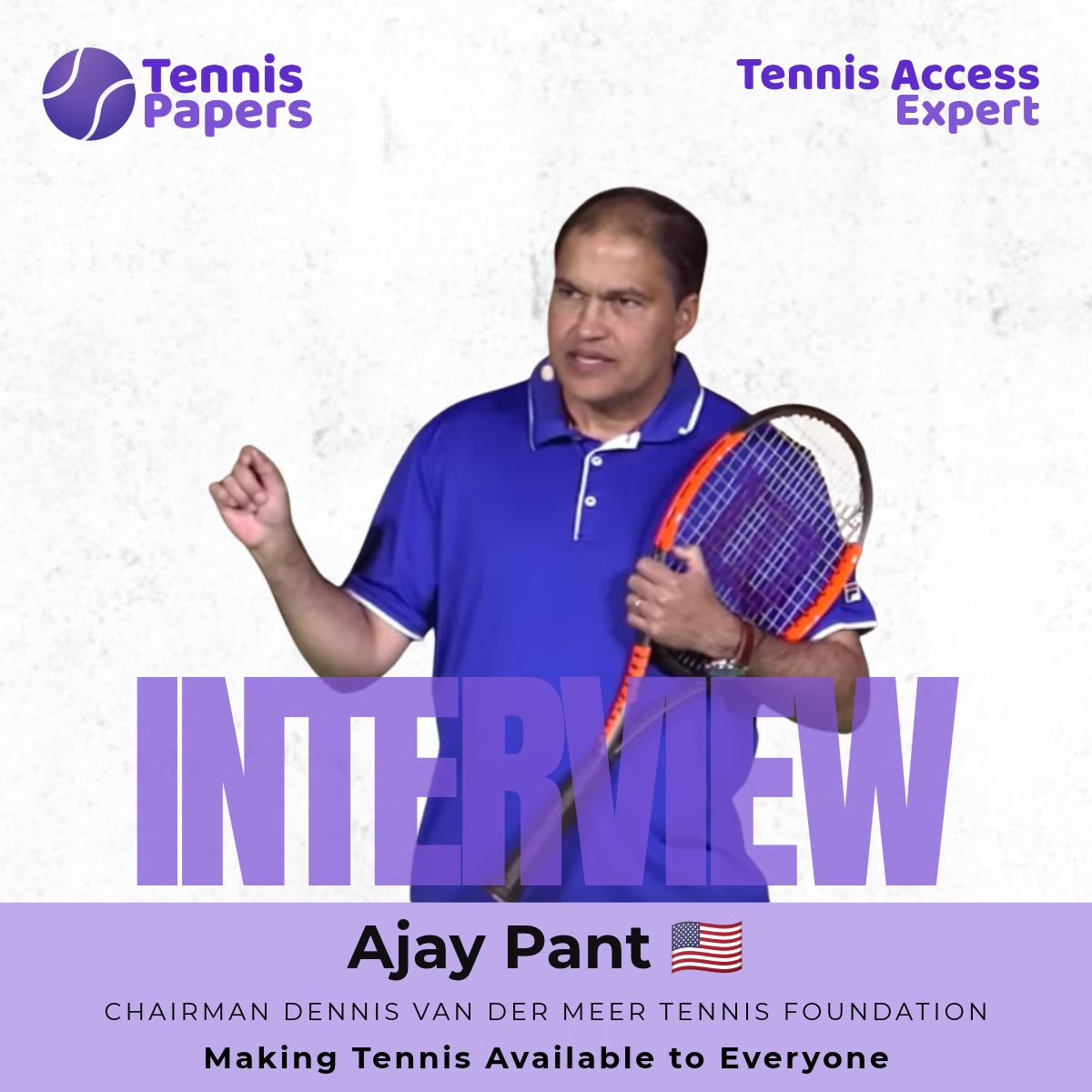
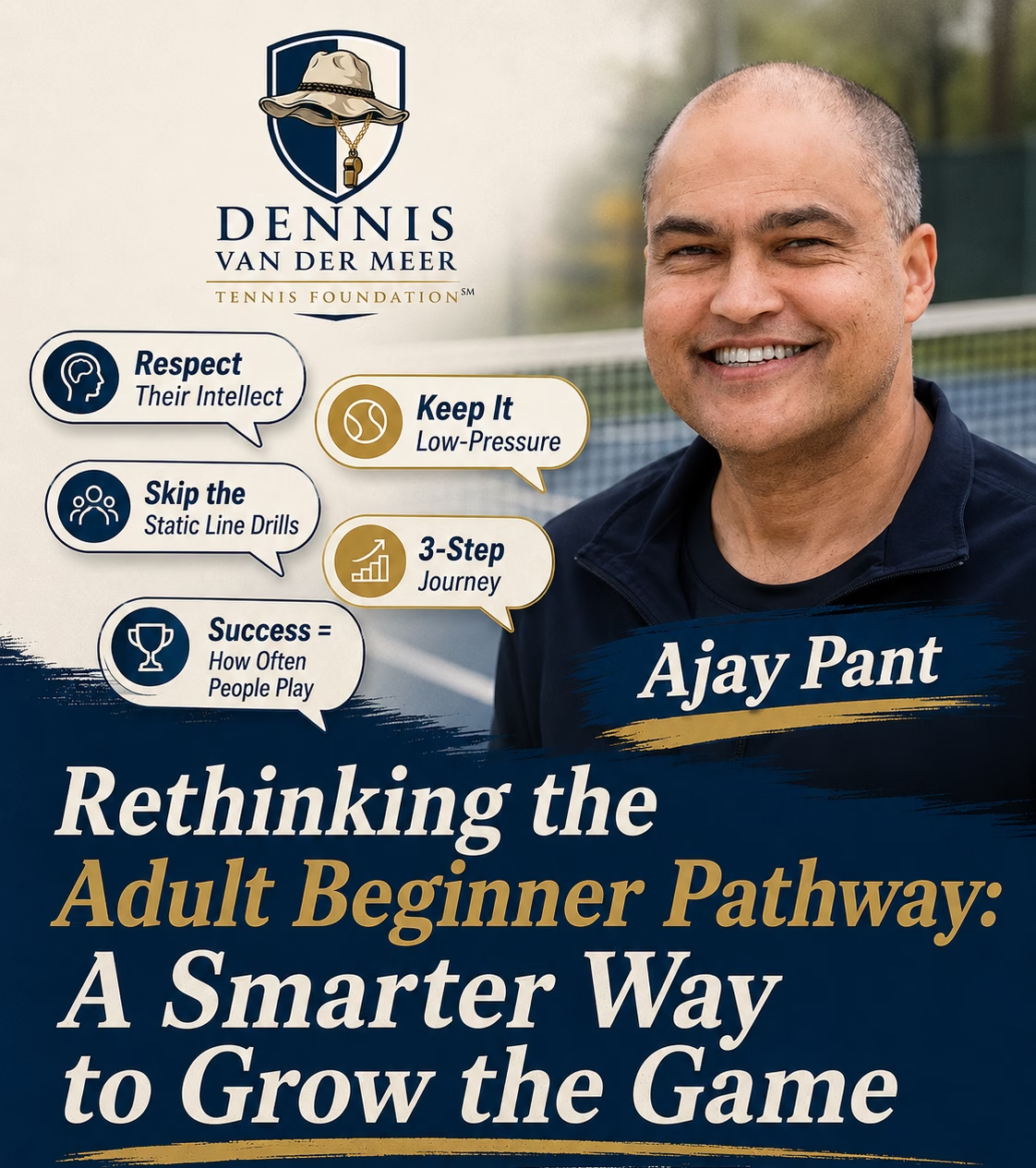
In this Dennis Van der Meer Tennis Foundation interview, Chairman Ajay Pant explains how the foundation helps make tennis accessible through grants, community programs and coach development. He shares practical guidance for families navigating financial barriers, from finding affordable training to approaching local supporters and building a sustainable junior tennis pathway.
Dennis Van der Meer Tennis Foundation Interview: Making Tennis Available to Everyone
Dennis Van der Meer’s Legacy and the Foundation’s Mission
The Dennis Van der Meer Tennis Foundation, formerly the Professional Tennis Registry (PTR) Foundation, is a U.S. 501(c)(3) nonprofit whose purpose fits in one line: “Making Tennis Available to Everyone.” We support deserving individuals and organizations around the world who bring tennis to people who would otherwise never get the chance to play.
Dennis personally wrote the Foundation’s mission: Making Tennis Available to Everyone. He was born in Namibia in 1933, became a teaching professional at 21, and moved to the United States in 1961. In 1976, he founded the Professional Tennis Registry, which today has more than 16,000 members in over 125 countries. He was known worldwide as the “Teacher of Teachers,” and in 2021 he was inducted into the International Tennis Hall of Fame.
Dennis believed in tennis for everyone. He wrote some of the first courses and manuals for wheelchair tennis and adaptive teaching, and he founded the Special Olympics North America Tennis Championships. When people doubted that wheelchair users could play, his answer was simple: “Oh, yes they can.”
Today the Foundation carries that vision forward in five areas:
- Under-resourced youth: grants to organizations that serve young people in under-resourced communities.
- Adaptive tennis and special populations: Special Olympics, wheelchair, blind and low-vision, and autism programs.
- Coach development: scholarships and continuing education, with an emphasis on certifying more women and multicultural coaches.
- Global goodwill: help building, redeveloping or refurbishing tennis facilities in under-represented areas, in the U.S. and abroad.
- Natural disaster relief: support for tennis communities rebuilding after events such as the Maui wildfires and Hurricane Helene.
Starting Tennis with Limited Financial Resources
Dennis believed a 10- or 12-year-old does not need an expensive academy to keep improving. They need regular court time, a good coach, and people around them who keep them in the game. Practical steps:
- Find a community or nonprofit tennis program. Many of the organizations we fund offer free or low-cost coaching, often with homework help, meals or transportation as well. In the United States, the USTA’s National Junior Tennis & Learning (NJTL) network is a good place to look. Outside the U.S., start with your national tennis federation.
- Connect with a certified coach. PTR has certified coaches in more than 125 countries, and many of them volunteer or offer reduced rates to promising juniors from families with limited means. A certified coach can also advocate for the child with clubs and programs.
- Ask the local club. Clubs often have junior memberships, hitting partners, off-peak court time or volunteer roles that families can trade for court access.
- Make the most of every hour. Wall practice, footwork, fitness and match play with friends cost almost nothing and add up quickly. Quality matters more than expensive hours.
- Keep school first. Strong grades open doors to college tennis and academic scholarships later, which is one of the most affordable routes to high-level tennis.
Financial Assistance Through Programs and Organizations
Our grants mainly go to organizations and programs, not to individual players. That lets one grant reach many children at once. The main types are:
- Grants and scholarships for under-resourced youth programs: for organizations with a strong, demonstrable record of serving under-served youth in under-resourced communities. Past grants have paid for coaches, equipment, and free summer programs.
- Special population and adaptive tennis grants: for Special Olympics, wheelchair tennis, blind and low-vision tennis, autism tennis programs, stroke rehabilitation and similar work.
- Coach development scholarships: for certification courses and continuing education for tennis teaching professionals. The PTR Italy Dennis Van der Meer Education Scholarship is a fantastic example of coach development scholarships.
- Global goodwill grants: for new tennis facilities or the refurbishment of existing ones in under-represented or devastated areas.
- Humanitarian awards and natural disaster relief: to recognize individuals who change lives through tennis, and to help tennis communities recover from disasters.
Applications come from the organization, club, facility or coach running the program, through the grant application form on our website. A family that wants support for their child should contact a local program, club or coach, who can apply for program funding that includes that child.
We have also funded a small number of individual college student scholarships, such as a four-year educational scholarship partnered with Southern Tennis Foundation.
Eligibility, Grant Amounts and the Application Process
The general grant program funds projects that carry on Dennis Van der Meer’s legacy, vision and spirit. Funding is limited to educational, life-enrichment, mentoring and tennis programs. Key points:
- Who applies: organizations, programs, tennis facilities or coaches who run tennis programs. We do not set an age limit, but our youth grants are aimed at programs serving young people in under-resourced communities.
- Amount: requests should not exceed $5,000.
- Timing: grants run in an annual cycle. Applications for the next round are reviewed starting in January, applicants hear back in early March, and grants are awarded in mid-April 2027.
- Location: we fund programs both in the United States and internationally.
Applicants need to fill out the grant application and add any videos or articles to support the request.
Opportunities for International Tennis Communities
Yes. Dennis’s own story began in Namibia, and the Foundation has always looked beyond the United States. Recent grants have supported a community tennis program for children in literacy and numeracy classes in rural Zambia (MCW Global), two consecutive years of grants and equipment for Youth for Tennis Liberia, an equipment donation and clinic for the Ghana Tennis Club in Adabraka, and many coaching scholarships through PTR Italy.
For juniors in Africa, Asia, South America and elsewhere, the best route is through a local program. A coach, club, school, or nonprofit working with young players in your community can apply for a grant for coaching, equipment, or court development, using the application on our website.
If you don’t know of one, start with your national tennis federation and local PTR-certified coaches. Organizations outside the U.S. are welcome to write to info@dvdmtennisfoundation.org before applying.
Players with real international potential should also ask their national federation about International Tennis Federation (ITF) development programs, which work through national associations.
Which Tennis Costs Can Charitable Programs Cover?
In our experience, the costs charitable programs cover most often are:
- Coaching: paying coaches so that lessons can be free or low-cost for children.
- Equipment: rackets, balls, shoes, bags and clothing. We often donate equipment along with funding, as we did in Liberia, Ghana and Zambia.
- Court access and facilities: building or refurbishing courts in communities that have none.
- Programs that support the whole child: free summer programs that combine tennis with academics, meals and mentoring.
Tournament entry fees and international travel are harder for charities to fund. For those, families should look to their national federation and regional association, which may offer junior player grants and development squads; to the ITF and continental development programs for international juniors; to local businesses and community groups (see Question 7); and to college tennis scholarships later in a player’s pathway.
Families can also cut costs significantly by choosing tournaments close to home, sharing travel and housing with other families, and buying good used equipment.
Approaching Sponsors with a Story and a Plan
Sponsors back a story and a plan, not just a ranking. Our advice:
- Write a one-page profile. Include who the child is, their results and coach’s assessment, their school record, and specific goals for the next 12 months.
- Ask for something specific. “$600 for four regional tournaments” or “two rackets and stringing for a season” is much easier to say yes to than a general request.
- Start close to home. Local businesses, the family’s employers, community and service organizations, faith groups, and the local club are the most likely early supporters.
- Offer something back. A logo on a shirt or bag, a thank-you on social media, a clinic for the sponsor’s employees’ children, or regular progress reports.
- Approach equipment companies and racquet shops through the coach. Manufacturers and shops usually start with product support, and requests from a certified coach or program carry more weight.
- Be reliable and say thank you. Send updates, report results honestly, and show how the support was used. That is how a first sponsorship becomes a long-term one.
Developing Without an Expensive Tennis Academy
Yes. Plenty of strong players developed through public courts, community programs, and a dedicated local coach. Dennis spent his career showing that good teaching, not an expensive setting, is what makes the difference. Affordable options parents should look at:
- Community and nonprofit tennis programs, such as NJTL chapters in the U.S. and federation-backed programs elsewhere
- Public parks and school courts, which are usually free or very cheap
- A certified coach for group lessons and semi-private sessions, which cost much less than private lessons
- School and high school teams, then college tennis, which offers both competition and scholarship opportunities
- Regional and national federation development squads and training camps for juniors who show promise
- Shorter academy camps or holiday sessions instead of full-time enrolment, for exposure without the full-year cost
Dennis also said, “Nothing stands still.” The game keeps changing, and a curious, hard-working junior with a good coach and a love for the game can keep moving forward on any budget.
How Foundation Support Makes a Difference
There are many. A few recent ones:
- Junior Tennis Champions Center (Prince George’s County, Maryland): our grant helped fund 10 weeks of free tennis and academics for 25 children, covering coaches, equipment, and classroom supplies.
- MCW Global, Zambia: we provided funds and equipment to start a tennis program for children attending literacy and numeracy classes at a rural community center. At a five-day training event led by Coach Butch Hines, about 90 children played tennis, many of them for the first time.
- Youth for Tennis Liberia: two consecutive years of grants, plus rackets, shoes, balls, and clothing, so children can take part in organized extracurricular tennis.
- Kendall Moody (Columbus, Mississippi): a student in the NJTL program with Golden Triangle Tennis, Kendall received a $1,000 annual Foundation scholarship for four years.
- Piedmont Area Tennis Association (Virginia): our grants support wheelchair tennis programming, camps, and tournaments. After one adaptive camp led by wheelchair tennis champion David Wagner and Paralympic coach John Devorss, PATA wrote: “Without the support of the foundation, this would not be possible!”
In each case, the support did more than pay bills. It gave children a coach, a racket and a place to belong. As Dennis put it about his own students: “If they enjoy it, I enjoy it.”

Three First Steps for Parents Seeking Support
- Find a coach and a program near you. Look for a community or nonprofit tennis program, or a certified coach who works with juniors. In the U.S., search for an NJTL chapter through the USTA. Elsewhere, contact your national tennis federation. Ask about free or reduced-cost places, loaned equipment and scholarships.
- Ask that program or club to apply for support. Organizations that run youth tennis programs can apply to the Dennis Van der Meer Tennis Foundation for up to $5,000. Share our grant page with your child’s coach or club, and encourage them to apply in the next round.
- Make a simple one-year plan and start building a support network. Work out the lowest-cost route to regular training and a few local tournaments, then approach local businesses, community groups and your club with a short profile of your child and a specific request.
Useful resources:
Key Takeaways for Junior Players & Parents
- Start with a local coach or community program. Ask about free or reduced-cost training, loaned equipment and accessible court time. Your national federation can help identify possible pathways.
- Understand who applies for foundation funding. Grants mainly support organizations and programs rather than individual players. A coach, club or nonprofit can apply for funding that benefits several young people.
- Explore opportunities beyond the United States. The foundation supports programs internationally. Organizations can contact its team before submitting an application.
- Keep funding requests focused and realistic. Foundation grant requests should not exceed $5,000. Coaching, equipment and community programs are more commonly funded than international tournament travel.
- Build a tennis pathway that fits the family budget. Group coaching, public courts, school teams and local tournaments can support development while limiting expenses.
- Give potential sponsors a clear story and a specific request. Prepare a short player profile, a realistic one-year plan and a precise explanation of how the support would be used.
- Keep education central to the journey. Strong school results can help open opportunities for college tennis and academic scholarships later.
Thank you to Ajay Pant and the Dennis Van der Meer Tennis Foundation for sharing these practical insights, and to Radhika Venkata for coordinating the interview. Your contribution helps players, parents and coaches understand how community support can make tennis more accessible.
Copyright & Editorial Reuse
© 2025 Tennis Papers. All rights reserved.
When quoting or referencing this exclusive interview, please credit Guillaume Laisne as the interviewer, identify Tennis Papers as the original source, and include a direct, clickable link to this interview.
Reproduction of substantial excerpts or the full interview requires prior written permission, except where permitted by applicable copyright law.
For further information, please consult our Terms of Use .
About Dennis Van der Meer Tennis Foundation
Dennis Van der Meer Tennis Foundation
Ajay Pant is Chairman of the Dennis Van der Meer Tennis Foundation. Formerly the Professional Tennis Registry (PTR) Foundation, the U.S. nonprofit continues Dennis Van der Meer’s mission of “Making Tennis Available to Everyone.” Its work supports under-resourced youth programs, adaptive tennis, coach development, tennis facilities and disaster relief in the United States and internationally.
Explore more interviews with junior tennis experts for practical insights on coaching, career management and health to support young players, parents and coaches.